
Why Afghanistan Currency Is Stronger Than Indian Rupee?
At first glance, it may seem surprising that 1 Afghanistan Afghani is worth more than 1 Indian Rupee. However, a currency’s exchange value alone does not mean that Afghanistan’s economy is stronger than India’s. Judging an economy solely by its unit value can be misleading. Here is why this happens:
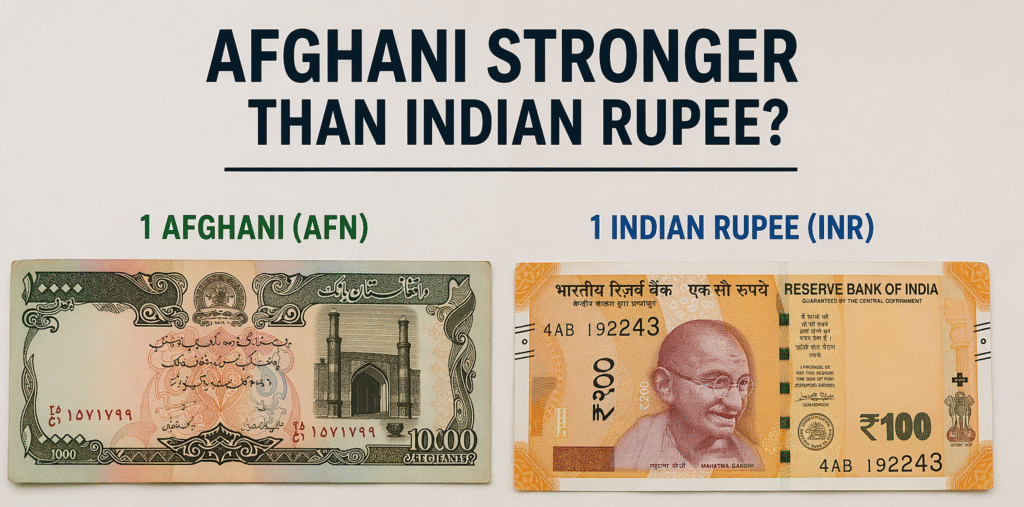
Economic Management vs. Economic Strength
A currency’s value depends on how it is managed rather than just the country’s wealth. India is a massive, fast-growing economy deeply integrated into global trade and investments. The Indian Rupee fluctuates based on imports, exports, foreign investments, and inflation. Because India imports huge quantities of goods like crude oil, there is a constant demand for the US Dollar, which puts pressure on the Rupee and keeps its unit value lower.
Strict Controls in Afghanistan
The situation in Afghanistan is very different. Its economy is small and largely disconnected from international markets. Recently, the authorities there have strictly controlled the supply of the Afghani. By limiting the amount of currency in circulation and restricting the use of US Dollars within the country, the value of the Afghani is kept artificially high. This strict control over supply is the primary reason it appears “stronger” than the Rupee.
Global Integration and Trade
- Low Imports: Compared to India, Afghanistan has much lower import volumes and limited economic activity. This results in less pressure from global trade on its currency.
- Open Economy: India is a global economic player. Being interconnected with the world means the Rupee is subject to natural market forces and global fluctuations.
Currency Value vs. National Wealth
It is important to understand that a “stronger” currency unit does not equal a “stronger” nation. For example, the Japanese Yen has a lower unit value compared to the US Dollar, yet Japan is an economic powerhouse. Similarly, while the Rupee’s unit value may be lower, the Indian economy is far larger, more stable, and more developed than Afghanistan’s.
In simple terms, the Afghani appears strong mainly due to strict regulations, limited circulation, and low global exposure. On the other hand, the Indian Rupee reflects a massive, active, and globally-connected economy.