Why India Dropped to 6th Largest Economy in 2025–2026
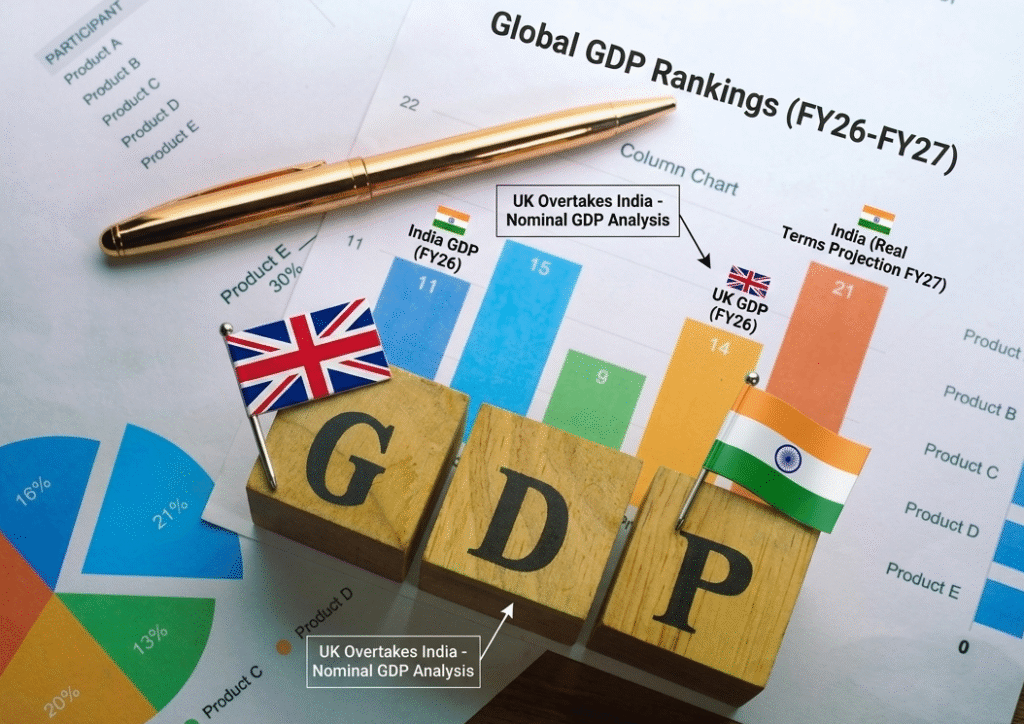
India’s position in the global economic rankings has recently seen a significant shift. After holding the fifth position for three consecutive years, India slipped to the sixth position in 2025 (FY26) and 2026 (FY27). The United Kingdom has overtaken India to reclaim its spot. While this news might seem concerning at first glance, the underlying story is more nuanced and essential for investors and readers to understand.
The Impact of Currency and Calculation
The primary reason for this shift lies in how global GDP rankings are calculated. These are typically measured based on Nominal GDP (in US Dollars). This means that even if the Indian economy is growing steadily in real terms, currency exchange rates can heavily influence its global standing. If the Indian Rupee weakens against the US Dollar while the British Pound remains strong, the UK economy may appear larger in dollar terms—even if India’s internal growth remains robust.
Economic Conditions and Recovery
Another key factor is the differing economic landscapes of the two nations:
- United Kingdom: The UK has achieved a period of economic stability and currency strength, which has boosted its Nominal GDP.
- India: Although India remains one of the world’s fastest-growing major economies, it faces external pressures such as inflation, global uncertainty, and rising oil prices. These factors can temporarily affect rankings without necessarily impacting long-term growth trajectories.
Why the Fundamentals Remain Strong
Rankings alone do not define economic strength. India continues to be a country with a powerful foundation built on:
- Demographics: A large and young population.
- Digital Infrastructure: Rapidly expanding digital connectivity and services.
- Domestic Consumption: Rising internal demand driving the economy.
In fact, most international organizations continue to predict that India will become one of the top 3 economies in the world in the near future.
Insights for Investors
For investors, this shift in ranking is not a negative signal but rather a reminder to look beyond the headlines. The Indian stock market is primarily driven by:
- Domestic growth narratives.
- Specific sector opportunities (Banking, Infrastructure, Manufacturing, and Tech).
- Long-term economic expansion.
These sectors continue to show resilience and potential despite temporary global fluctuations.
Global rankings are fluid; they change frequently based on exchange rates, government policies, and international economic shifts. India’s temporary slip to sixth place is a reflection of global dynamics rather than a decrease in its economic potential. As the country continues to invest in infrastructure, innovation, and reforms, it is well-positioned to regain its standing.
Ultimately, while the ranking change is noteworthy, it must be viewed in the proper context. India’s growth story remains strong, and it is crucial for stakeholders to focus on the big picture rather than short-term fluctuations.